The first impression
Back to all places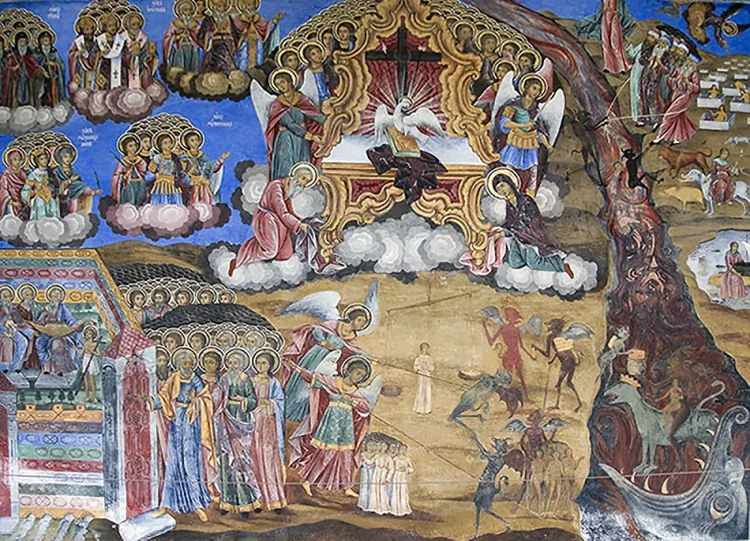
As you stand east of the Hrelyo Tower, gazing at the majestic main church of Rila Monastery, you are about to witness a visual feast that encapsulates centuries of faith, artistry, and history. The exterior walls of the church are adorned with frescoes, a testament to the masterful skill of artists from the Samokov School of painting. These murals, completed between 1840 and 1847, tell stories from the Bible, the lives of saints, and pivotal moments in Christian theology, inviting onlookers into a world where every color and line speaks of devotion and heritage.
The team behind these spiritual narratives included the brothers Dimitar and Zahari Zograf, along with Joanikii and the notable Kosta Valiov. Additionally, Dimitar’s son, Zafir (Stanislav Dospevski), contributed to this monumental project, marking a period of rich artistic production that saw the Samokov School rise to prominence in Bulgarian art history.
As you move closer, let yourself be drawn into the intricate compositions that cover the church’s façade. These paintings are not just decorations; they are sermons in color, meant to educate and inspire the faithful. The use of vivid hues, dramatic expressions, and meticulous attention to detail in these frescoes is characteristic of the period’s style, reflecting a blend of post-Byzantine and medieval Bulgarian influences.
In the western part of the naos (nave) from 1842–1844, a vast array of frescoes covers the interior, depicting scenes from the lives of saints, biblical parables, and significant theological motifs. Among the depicted are Saint Martyrius, Saint Markian, and scenes like the Cherubim turned towards God’s radiance, Saint Anthony of the Caves delivering a scroll with a message of brotherly love and salvation, and Saint Theodosius of the Caves. The frescoes include depictions of Saint Dimitar of Rostov, the communion of Saint Zosim to Mary of Egypt, and the martyrdom of various saints like Saint Kirik and Saint Julita, showcasing the rich spiritual heritage and the veneration of martyrdom in Orthodox Christianity.
The frescoes are not limited to representations of saints and martyrs but also include detailed narrative cycles, such as parables from the New Testament, providing visual exegesis of biblical teachings. For example, the Parable of the Sower, the Parable of the Light and Darkness, and the Parable of the Wise and Foolish Builders are depicted, emphasizing moral and spiritual lessons central to Christian doctrine.
Noteworthy is the extensive representation of the Akathist Hymn to the Theotokos, with individual scenes illustrating the hymn’s oikoi and kondakia, such as "Silent Force" and "Seeing the strange childbirth." These representations underscore the Virgin Mary’s significant role in Orthodox spirituality and her veneration as a protector and intercessor for the faithful.
In the northern gallery, the frescoes from 1846 continue the tradition of intricate and symbolic representation, with scenes like the Last Judgment and the lives of prophets, saints, and biblical figures such as Saint Nikola on the throne, the Parable of the Fig Tree, and the Dormition of Saint Nikola, further enriching the theological and iconographic landscape of the church.
The cycle on the history of Adam and Eve, from creation to their life after the Fall, provides insight into human nature, sin, and redemption, a theme central to Christian theology.
Finally, the frescoes culminate in the depiction of the Symbol of Faith (Creed), surrounding the dome with the full text, encapsulating the core of Orthodox Christian belief and the eschatological hope of resurrection and eternal life, affirming the church’s role as a space for spiritual reflection, teaching, and communion with the divine.
One cannot help but admire the way these artists have captured divine mysteries and human emotions alike, creating a bridge between the earthly and the heavenly. The frescoes on the exterior serve as a prologue to the spiritual journey awaiting inside, preparing the heart and mind for reflection and prayer.
As this chapter of your visit draws to a close, and you prepare to step into the church, remember that the artistry you see is more than just an aesthetic achievement. It is a vibrant thread in the fabric of Bulgarian culture and Orthodoxy, a link to a past where faith was expressed in the language of paint and plaster, and a reminder of the enduring power of sacred art to move and uplift the human spirit. Let the beauty of these frescoes be a gateway to deeper understanding and appreciation of the spiritual heritage housed within the walls of The Church of the Nativity of the Virgin.
42.13356, 23.34007