The complex
Back to all places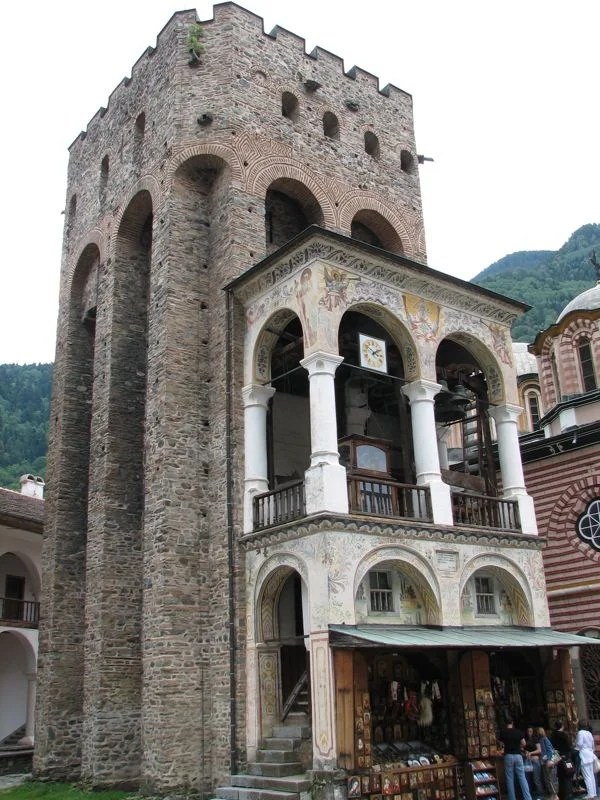
When Ivan died he already had his group of followers who had settled in the cliffs around his cave and established a monk brotherhood. After 946 Ivan was canonized by the Bulgarian King Peter the first and the first monastery was recognized by the authorities. The monastery was around the cave, 4 kilometers up on the road from where you are standing. A church was built, and it is still standing there, next to the cave of Ivan, which became his tomb. The place became a center of pilgrimage but the turning point of its glory came when the saint’s relics were moved to Sredets (modern Sofia), fostering the cult within the Byzantine Empire. The monastery’s destiny intertwined with the political and religious movements of the relics, marking the beginning of its significant historical trajectory.
The monastery remained in that location for the next 300 years. In the 14th century, the monastery found a new guardian in the person of Stefan Hrelyo Dragovol, a local administrator, who is credited with reestablishing the monastery a little before 1334 and 1335. He constructed the Hrelov Tower and a church dedicated to St. John of Rila, suggesting a strategic relocation to its current position, nestled at the confluence of the Rila and Drushlyavitsa rivers. This era marks a significant period of architectural and religious fervor, laying down the foundation for the complex we admire today. The 14th century was full of turbulences which in the end led to the fall of the Bulgarian kingdom under Ottoman rule. But despite that, Bulgaria was torn to pieces by civil conflicts, plague, and decentralization. Of course, this was true for all the Balkan states at that time.
As centuries unfolded, the monastery experienced periods of both prosperity and decline. The Ottoman conquest of Bulgaria brought about a phase of suppression, with the monastery facing numerous challenges to preserve its religious significance and cultural heritage. Despite these hardships, it remained a symbol of Bulgarian spiritual preservation. A very interesting fact is that during the Ottoman conquest, the monastery received the protection of the Sultan directly after an official edict was decreed which unfortunately didn’t protect it forever. It became a constant target for raids especially in the early 19th century when the Ottoman Empire decided to get rid of its main military structure- the Janissary Corps. The Janissaries were the symbol of the archaic imperial structure who became the unwanted child of the Sultan in his vision of the modern Ottoman empire. This struggle became a civil war which led to atrocities of the population of the Balkans beyond any scale. The conflict ended in 1826 during the reign of Sultan Mahmud the Second.
Another challenge for the Rila monastery was The Fire in 1833. A pivotal moment came on January 13, 1833, when a fire devastated the monastery, sparing only Khrelio’s Tower and the old main church. This disaster led to a formal request with the Ottoman authorities for refurbishment, culminating in the construction of a new katholikon. Despite financial challenges and controversies among the brethren, the new main church was completed under the guardianship of appointed ephors, showcasing the resilience and communal spirit of the monastery’s inhabitants. The new main church, a cruciform basilica with three naves and two side conches, is a masterpiece of its era, reflecting both tradition and innovation in its design. Master Pavel, the architect from Krimini, along with his assistants, executed a design that was both a continuation of and a departure from the old Khrelio’s church, illustrating a seamless blend of history and modernity in its architectural essence. To imagine the enthusiasm note that the church was finished in just 3 years between 1834 and 1837. Of course, the medieval structures were recycled but still, it was an amazing achievement.
Until 1947 the monastery lived through its Golden age. It became a center of education and knowledge beyond the religious aspect. People were trained to become teachers in the newly formed education system in the Bulgarian lands. Some artifacts of those times can be found in the history museum in the complex, situated behind the main church. The library was filled with thousands of texts from the Middle Ages till the present. Modern scientific disciplines were thought also and were included in the teaching. The monastery was populated by 200 monks. Hold a little bit now. Remove with your imagination all the tourists and replace them with those 200 black-dressed monks, walking around doing all kinds of things. Add to them the adults who were here to become teachers. Imagine the smell of the kitchens preparing the food for those people. It starts looking a bit like Hogwarts, is it not?
Anyway, lets get back to the reality, shall we?
In 1947, after a bloody and dramatic revolution Bulgaria became a Communist state, which was never part of the Soviet Union, but of course under its influence. You probably know that the Communists were not big fans of the church so the monastery was closed as an active temple of worship. But also during this time period it was accepted in UNESCO World Heritage list and it was restored and perfectly maintained.
Despite the challenges of the socialist era, when the monastery was not active, it regained its status as an active monastery in 1991, once again becoming a beacon of faith and Bulgarian heritage. Today, as you are exploring this sacred complex, you’re not just walking through a historical site but a living monument to Bulgaria’s spiritual journey, a place where every stone tells a story of faith, resilience, and cultural identity. Today only 8 monks are living here actively doing nothing than collecting taxes and enjoying the services of 80 people who are working in the complex. But this is kind of a charm typical for all such institutions around the world and regardless the Era. Anyway, lets continue our tour and explore the most interesting building of the complex, the main church of the Rila Monastery. Let’s go.
42.13372, 23.33995