The Bulgarians
Back to all places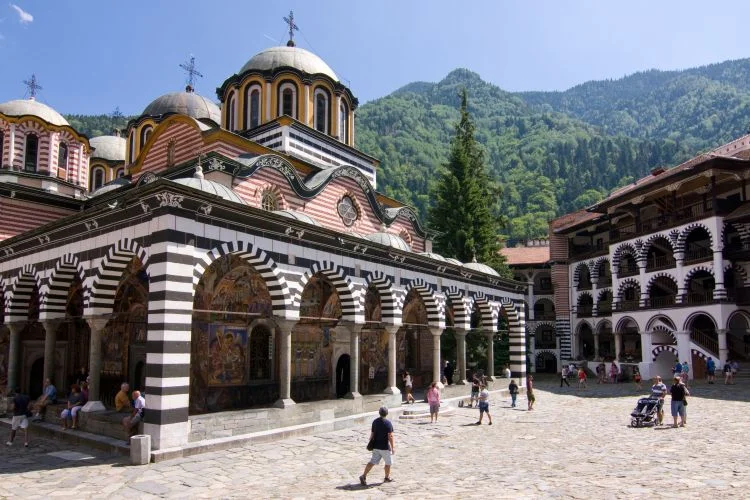
The complex that you are seeing around you was constructed in the late 19th century. But as you know already, the History of the place is much longer than that. The Monastery is dedicated to Saint Ivan of Rila, but who was he? Why the biggest monastery in the Balkans is named after him? Before answering those questions, we should dive just a bit below the surface of the History of Medieval Bulgaria and, more precisely, the 9th and the 10th centuries. It is extremely difficult to tell a story by starting from the middle of it, rather than from the beginning, whatever that means, but we should put this time frame because instead of an audio guide we can end up with a little book, which believe me, the monks won’t let you finish because the working time of the Monastery is till 19 o’clock.
In 864, the Bulgarian ruler Khan Boris was baptized, and Christianity became the state religion, replacing the mixture of different religions in the Bulgarian kingdom. Christianity was already spread among the Slavic ethnicity, but there were also religions brought by tribes who migrated with the Bulgarians in the 7th Century. One of the most popular was the cult of Tangra or Tengre. This religion is still recognizable in modern Mongolia. This was the main cult of the Steppe peoples who were interacting with the Bulgarians for centuries. The Bulgarians were part of Attila the Hun’s confederation in the 5th century. Many historians still believe the cult of Tangra was the main religion of the Bulgarians before the adoption of Christianity but their opinion is not supported by many medieval sources. Unfortunately, as everywhere in the world, history is used by the political needs of the day. During the Communist era, the Bulgarians were proclaimed to be part of the Turkic tribes that inhabited the steppe. Later, they mixed with the huge Slavic population, which settled in the East Roman Empire in the 6th Century, and the Bulgarian ethnicity emerged. But modern research is showing otherwise. The Bulgarians are most probably related to the Persians, and they have adopted Zoroastrianism, which continued to be the main religion of the royal dynasties until the Christianization. As I have mentioned earlier, the Bulgarians had joined forces with Attila, but when he died and his empire collapsed, together with some steppe tribes, they went back east. In 632, the first Bulgaria appeared on the map. We call it The Great Bulgaria. It had enormous territories on the other side of the Black Sea and was probably more like a confederacy rather than a unified state. Unfortunately, it didn’t last long, and when the great ruler Khan Kubrat died, everything collapsed. Part of the Bulgarians, led by Khan Asparuh, after a decisive victory over the East-Roman Empire in 680, managed to settle South of the Danube River and established their own Bulgaria. We will skip the next 2 centuries and the story of the other Bulgarias that existed in the same period to avoid the book that I mentioned and reach again the moment of the Christianisation of Bulgaria. As you can imagine, the transition to Christianity wasn’t peaceful, and 52 families had to be exterminated so the new order to prevail. Not very long after the establishment of the Christian institutions by Constantinople, the Bulgarian rulers started to look for a way to escape the influence of the East Roman Empire, which led to the development of the Cyrillic alphabet, which also became very useful to the rulers of Kyiv Rus when they had a very similar situation. This is why Russia uses the Cyrillic even today. When the turmoil of the political and religious changes eased, a group of devoted fanatics emerged- so-called the hermits. They are not a local phenomenon because such groups exist everywhere in the early Christian world. Such people existed in Egypt in the 2nd century and became like hippy fashion in Europe and in the Middle East. Such a person was Saint Ivan of Rila.
42.13324, 23.33975