King Boris’ grave and the Relics of Ivan of Rila
Back to all places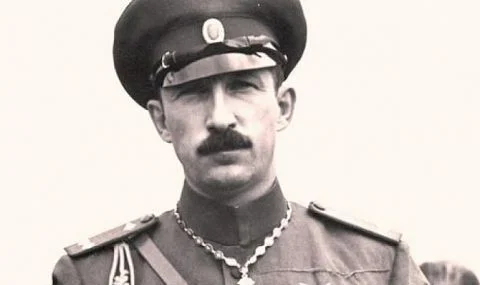
Now, let’s have a look on the right side of the church. You will find a niche with the grave of the last Bulgarian king Boris the Third. He hailed from the House of Saxe-Coburg and Gotha-Koháry, a European dynasty that came to rule Bulgaria in a rather circuitous manner. The dynasty’s connection to Bulgaria began with Ferdinand I, who was elected Prince of Bulgaria in 1887. Ferdinand, originally a prince from the German duchy of Saxe-Coburg and Gotha, ascended to the Bulgarian throne after the abdication of Alexander I of Battenberg, during a period when Bulgaria was striving for autonomy from Ottoman rule.
Ferdinand’s reign saw significant challenges, including Bulgaria’s push for independence and territorial unification. During his tenure, Bulgaria found itself embroiled in the Balkan Wars (1912-1913) and World War I. The Balkan Wars were a complex series of conflicts that ultimately led to the enlargement of Bulgarian territory. However, the subsequent Treaty of Neuilly after World War I was a harsh setback, stripping Bulgaria of much of this territory and imposing heavy reparations. The national trauma and economic strain from these events were profound.
Boris III succeeded his father Ferdinand in 1918 after Ferdinand abdicated in the wake of World War I’s fallout. Boris III’s reign marked a significant departure in terms of the monarchy’s connection to the Bulgarian people, as he was the first Bulgarian monarch to bear a traditional Bulgarian name, signaling a closer affinity with the national identity and heritage.
His rule was a tumultuous time for Bulgaria, navigating through the political instability of the interwar period, the buildup to World War II, and the war itself. Notably, Boris III is remembered for his complex role during World War II, particularly for his efforts to protect the Bulgarian Jewish population from deportation to Nazi concentration camps. Despite Bulgaria’s alliance with the Axis powers, Boris III, with support from the Bulgarian Orthodox Church and various political leaders, managed to resist German demands for the deportation of Bulgarian Jews, saving thousands of lives.
Another significant aspect of Boris III’s reign was his refusal to send Bulgarian troops to the Eastern Front to fight alongside Nazi Germany against the Soviet Union. This decision was in line with his attempts to maintain a degree of neutrality, despite the pressures from Germany. This strategy didn’t save Bulgaria from the savagery bombardments by the Allies. Sofia was devastated and turned to ash in 1943 and 1944.
The circumstances surrounding Boris III’s death in 1943, after a meeting with Adolf Hitler, remain a subject of speculation and controversy. Officially, his death was attributed to heart failure, but many believe it was a result of poisoning or other foul play, considering the tension between Boris’s refusal to fully commit to Nazi demands and Hitler’s known reactions to such defiance.
Following Boris III’s death, Bulgaria faced a political crisis, which, coupled with the advancing Soviet Army, led to a coup in 1944. Subsequently, Bulgaria switched sides and declared war on Germany. The immediate post-war period saw Bulgaria falling into the Soviet sphere of influence, leading to the abolition of the monarchy in 1946. The royal family, including Boris’s son Simeon II, went into exile in Spain. In 1947 the Bulgarian Communist party took full power over the political life of Bulgaria and established a new regime of Georgi Dimitrov. Mr. Dimitrov is an astonishing figure too but once again we have to remind ourselves to avoid making a book.
The son of Boris Simeon II made a remarkable return to Bulgarian politics by becoming the Prime Minister of Bulgaria from 2001 to 2005, after his party, the National Movement Simeon II, won a significant number of seats in the Bulgarian parliament. This event marked a unique instance of a former monarch returning to lead his country in a different capacity. But as usual, politicians make the opposite of what they are promising. Despite his promises that he would never do that he claimed the properties of his father, including forests, palaces, and other real estates. This move led to his political catastrophe and he disappeared as a major political player.
Regarding Boris III’s burial, he was initially interred at the Rila Monastery, a significant spiritual and cultural site for Bulgaria. This choice reflected his and the Bulgarian Orthodox Church’s role during his reign. However, the post-war communist government, aiming to erase the monarchy’s legacy, moved his remains to a small chapel within the park of the royal estate, Vrana Palace, on the outskirts of Sofia. In 1954, under the order of communist leader Vălko Chervenkov, the chapel at Vrana Palace was blown up with explosives and leveled to erase any trace of the burial site. The location of the actual body was lost, and to this day, the main remains of Boris III have never been recovered. Following the fall of communism in 1989, a parliamentary committee investigated the destruction of royal monuments. During excavations at the former chapel site in Vrana Palace in October 1991, archaeologists made a remarkable discovery: a preserved glass jar containing the Tsar’s heart, which had been extracted during his original 1943 embalming. On August 23, 1993, marking the 50th anniversary of his passing, Tsar Boris III’s heart was solemnly reinterred at his original burial niche inside the Rila Monastery Cathedral.
The story of the House of Saxe-Coburg and Gotha-Koháry in Bulgaria is a compelling narrative of royalty, political intrigue, and national identity, with King Boris III’s legacy particularly standing out for his wartime leadership and moral stance during one of Europe’s darkest periods.
So, now let’s go to the final chapter of our journey. Head toward the central Iconostas that is covering the Altar of the church. On its right side, you will see a little box covered with a blue or red blanket. If the blanket is open, probably there is a big holiday and it is good to ask someone around you.
The most holy relics of the Complex are standing in front of you. Despite that, nothing looks as spectacular as you would imagine and expect. Here are supposed to be the remains of Saint Ivan of Rila. His hand and a few more bones are believed to have survived through all the years, movements between Rila, Sofia, Hungary, the old Bulgarian capital Veliko Tarnovo, and in the 17th century back in Rila, all the fires and destructions, of course, it is believed that they are making miracles and probably remaining in one piece, after all, is one of them. But if you think about it, it is not really important whose hand is lying in the little glass box. It is important that people believe that they are the real ones and that they are still looking for help in their times of need. And as we know, faith is a huge power and has pushed people to do unbelievably stupid things but also, sometimes, great ones.
42.13338, 23.34031