Inside
Back to all places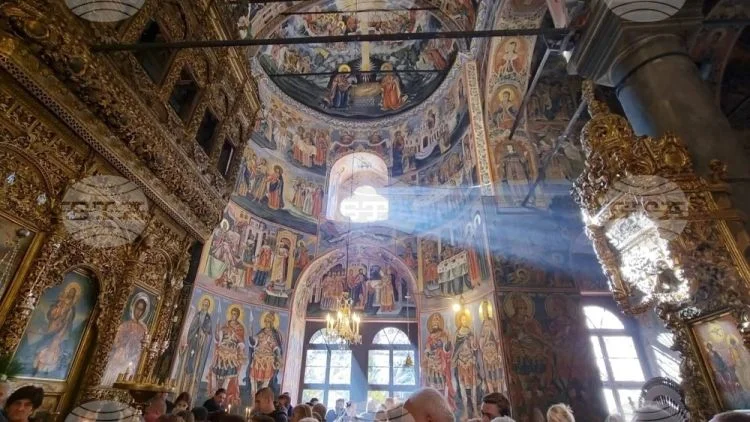
Upon entering the main church of Rila Monastery, you are immediately enveloped in a realm of spiritual narratives, vividly told through the frescoes that adorn every inch of its interior. The interior decoration was a monumental task undertaken between 1834 and 1847, involving a cohort of icon-painters led by the eminent names of the Samokov School, including John the Icon-painter, Kosta Valiov, the Christovs brothers Dimitar Zograf and Zahari Zograf, as well as Dimitar’s son Zafir. These artists brought to life the walls of the church, creating a visual bible that narrates the life of Christ, the saints, and the rich tapestry of Christian doctrine.
The altar area, traditionally starting the decoration process, was completed by 1842, with Kosta Valiov and John the Icon-painter at the helm. They set the thematic and stylistic tone for the church’s interior, focusing on the Redemption Sacrifice of Christ, a theme intricately linked to the Orthodox liturgy and its sacred rituals.
As you move through the church, the frescoes unfold in a deliberate sequence designed to guide the faithful through the Christian narrative. The nave, divided liturgically by its three domes, showcases the major doctrines of Christianity through iconic representations such as Christ the Pantocrator, the Holy Trinity, and the Virgin Hodegetria. These images are not just decorative; they are theologically potent, demarcating the nave’s liturgical spaces and imbuing the entire church with a sense of divine presence.
The choirs, adorned with scenes from the Incarnation and the Public Ministry of Christ, bridge the space between the divine and the earthly. Here, the icon-painters have meticulously followed the Hermeneia by Dionysius of Fourna, ensuring that each scene, from the narratives of Christ’s life to the depictions of the saints, aligns with the Orthodox Church’s liturgical and doctrinal foundations.
The fresco program extends beyond the nave into the open gallery, where the themes of the Last Judgment, the Incarnation, and local rituals related to the monastery’s sacred icons are explored. This space, integral to the church’s liturgical function, serves as a visual catechism, instructing the faithful in the tenets of their faith through the language of art.
42.13335, 23.34003